
Ship the Wellness Version, Wait for the Evidence
How companies can "double dip" thanks to the FDA

A 25,000 person waitlist. A perfectly legal route to market months or years earlier than you might face. Women clamoring for more information about their bodies after years of being told to just wait.
Well, why not just get your product to market now and hope the evidence follows? It’s a fast track to revenue and a pathway that is baked into the FDA regulatory process.
You think that sounds ridiculous? It’s not. It’s a savvy business strategy. Albeit not without risk.
Because what if the evidence that follows isn’t what you were hoping for? But that’s a topic for another day.
Clair Health is one company getting a lot of attention and shows us a very clear example of the wellness versus regulatory conundrum. They also aren’t hiding their strategy. It’s part of their pitch and likely very responsible for their recent $11.6M raise from investors including Khosla Ventures and Anne Wojcicki (of 23 and Me).
Version 1.0 launches as a “wellness” device and offers “continuous hormone insights.” They promise the ability to align your training and recovery days, your fertility concerns and your overall well-being with your hormone patterns. There is no FDA submission required because none of that crosses into a diagnostic or disease-related claim.
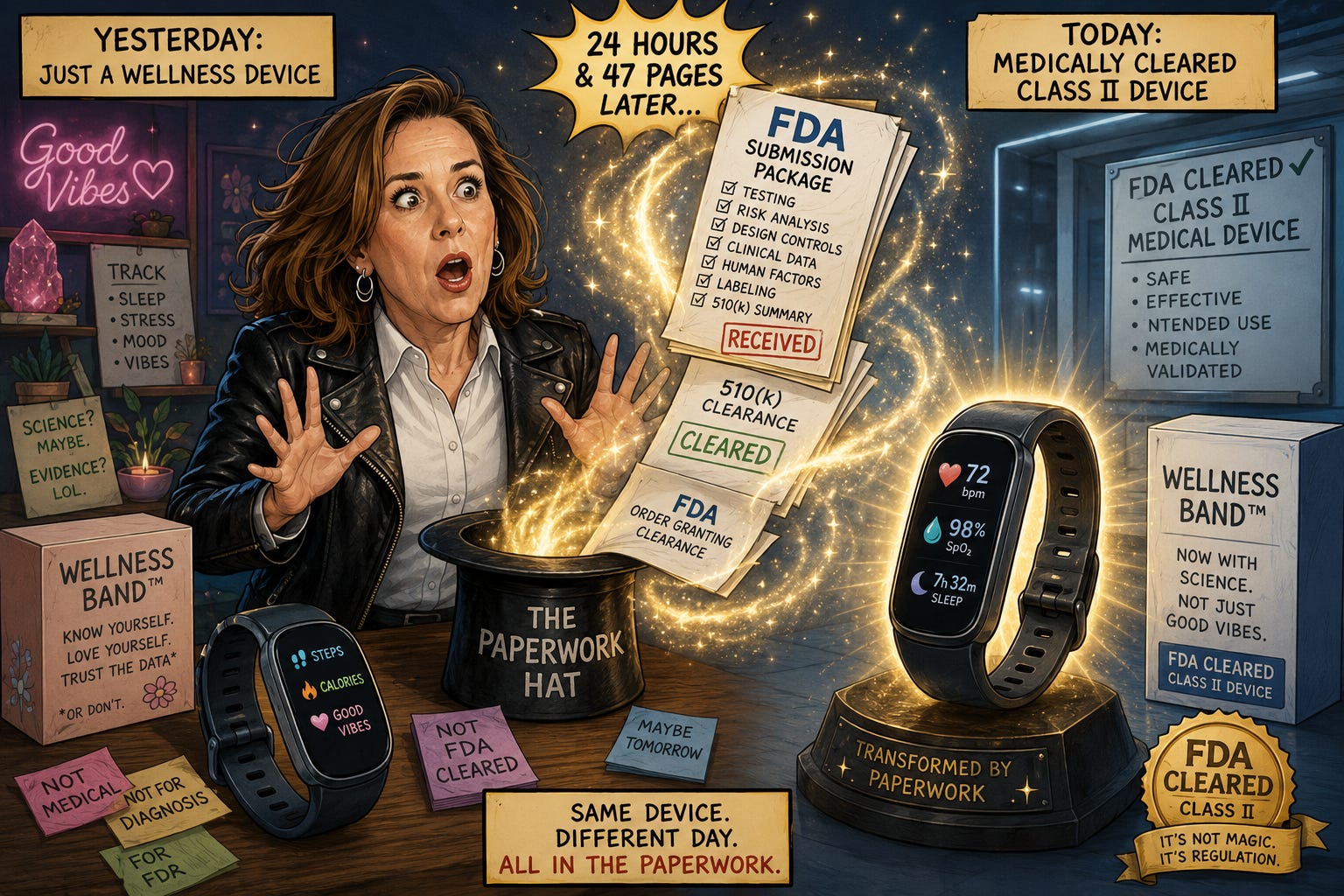
But Clair 2.0. Same hardware. Same algorithm. Just an over-the-air update sent to that exact same device after 510 (k) clearance is in hand. Well, that will provide the “actual” hormone numbers as quantitative values. Estradiol in pg/mL, progesterone in ng/mL, LH and FSH in mIU/mL. Those values are what the FDA clearance is for. Everything else can ship right now as a stylish wellness feature.
Clair Health is not playing a trick. What they are doing is not illegal or even unusual. It’s a very rational response to a system that makes the “wellness” lane fast and free and the “medical” lane slow and expensive. The company has been very transparent about the staging of the release. The decision to release an unregulated version first isn’t just about shortcutting the regulatory pathway. It’s a business strategy. They are getting a product (with a 25,000 person waitlist!) into the world months or years before a submission would allow. On hardware that is aimed squarely at fertility tracking, perimenopause and “hormonal health” categories where women have historically been told to wait for a doctor to take them seriously.
Assuming their clinical study goes as planned, the FDA clearance and subsequent relaunch become the moment when the same object, same data but now with numbers, can be marketed as more legitimate than it was the day before. Even though nothing about the device on your wrist has changed. I refer you back to the word: “identical.”
It’s like magic.
Legitimate business strategy, quick pathway to revenue and very appealing (clearly) to investors.
But here is the issue I take with this. Are women really winning?
If a product is unregulated then you are told (correctly) not to treat the information as medical while the marketing quietly invites you to do exactly that. If the product is FDA cleared, then suddenly it’s “medical-grade.” I don’t know about all of you, but when I hear that, I think scientifically validated. But it’s not. That 510 (k) designation means “substantially equivalent” to something already on the market. Not validated as accurate. Just not meaningfully different from a device that has already cleared that low bar.
And yet that little piece of paper allows you to market your device as if it will meaningfully change the health of women. Yesterday was a “nice to have” and today is a “must have.” Even if your doctor doesn’t know what to do with it.
The jury is out. We’ll have to wait for the evidence. That arrives after your product has shipped.
Well, investors invest to make money, not to improve human health. It is not charity; it is business.
I think the problem lies in the investors; they aren't willing to fork over the cash for a "real" medical device with actual evidence. They want a quick win, quick traction, quick revenue. So if they can raise a small amount, get sales and traction, then they can go on to raise more to get the clearance. So if anyone is to blame for women not getting the devices they deserve, it is the investors. They chose to invest in Clair over anything else...