
FDA "Clearance"
The subtle nuances mean a world of difference

I just love talking about a few things. Duck vaginas are one of them. The world of “continuous hormone monitoring” is another. Sometimes people listen. And comment. Like the time someone from Mira thanked me for bringing attention to the issue and declared themselves an “FDA Class I medical device.”
Which gave me the opportunity to point out some other “FDA Class I medical devices.”
Paw patrol band-aids
A rubber exam glove blown up with a turkey face drawn on it
A tongue depressor that you re-purposed to make home-made popsicles
These, my friends, are all Class I medical devices. Just like the Mira at-home hormone monitoring device.
This is not a post about Mira or Clair Health or anyone else pursuing the holy grail of continuous hormone monitoring. It’s a post about the difference between FDA classifications. Because before you can judge the utility of any “regulated” device, you need to understand what those regulations mean. (I’m limiting myself to the FDA today, because there’s enough to talk about here without going into the rest of the world.)
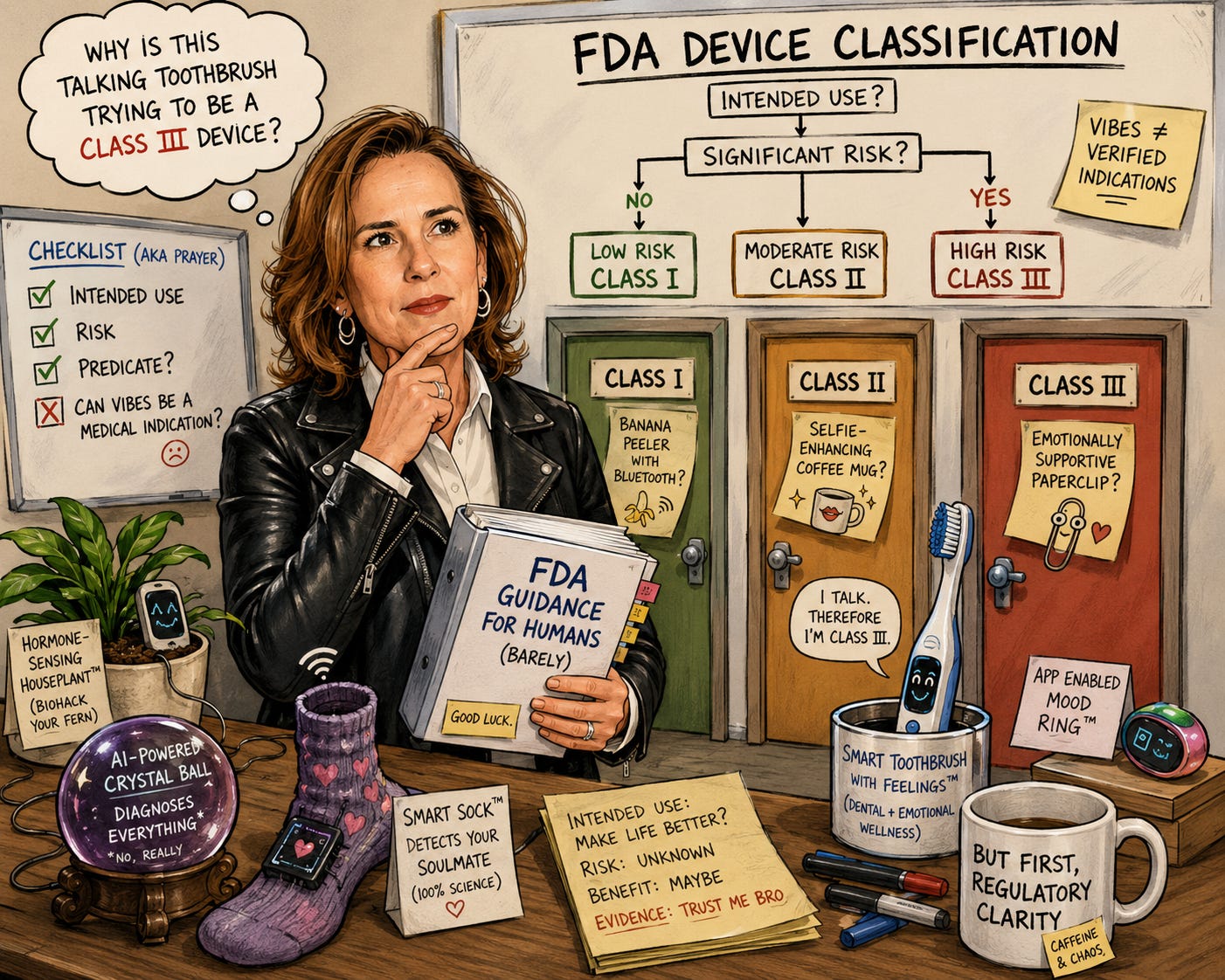
FDA Medical Device Classifications: an overview
The FDA lists 3 general groups of medical devices and the class determines what type of authorization is required before selling your product.
Class I: Low-risk. Requires your basic controls over manufacturing and adverse events. No requirement for annoying and expensive things like clinical data.
Class II: Moderate-risk. The same “General Controls” as above plus specific controls that are tailored to the device’s risk profile. Most devices go through something called “510 (k) clearance” prior to hitting the market. That means it is “substantially equivalent” to another device already out there. If it truly novel, then it could apply for DeNovo classification assuming it is low/moderate risk.
Class III: High-risk. Clinical evidence of safety and effectiveness are required. Expensive. Lab and animal testing followed by clinical trials in people.
FDA approval is a high bar. This means the FDA has determined that the benefits to the device outweigh its risks. That means it has to not only do what it says on the tin but what it does that is good for you is more important than what might not be good for you. For example. A hormonal IUD carries some risk. In about 1 in 1000 cases, an IUD can cause uterine perforation. That means it pokes a hole in the uterus wall and that is a problem. However, preventing pregnancy is considered well worth that risk.
FDA cleared simply means that the FDA agrees that the device is similar enough to an existing product (510 (k)) or is low enough risk as a new (DeNovo) device that it’s good to go. Importantly, that already-in-existence device doesn’t have to be safe. In some cases it might not work or has been recalled. This is a known flaw in the system. However, it does mean some level of FDA oversight required before selling that doohickey.
Which brings us to that old bugaboo…
FDA Registration
If you plan on selling a medical device in the US, you need to file a registration with the FDA. This means the name of your company is entered into a little database that means the government can come and find you in the event of an emergency. Your product is not tested, certified, cleared, approved or otherwise scrutinized. It’s the equivalent of putting your name in the phonebook and then hoping no one calls.
And there you have it. Being an “FDA registered Class I medical device” is as big a governmental stamp of approval as, well, a license plate on your car. Whether it turns on, has usable brakes or a steering wheel that turns is anyone’s guess.
Hopefully that helps and I’ll link back to this glossary of regulatory terms as I continue to poke holes in all that unregulated noise out there that is targeted at women who want to understand their bodies and take control of their health. Or just read my musings on the duck vagina.
Not many people know the difference between FDA-registered, FDA-cleared, and FDA-approved because of the way the words get thrown around. I wish they made an FDA Clearance card or something, like a driver's license. Something I can show to people that proves I passed the test and am safe to ride the roads (not just paid my dues like a plate).